
Right-Click, View Source: Why AI is Bringing Back the Web’s Wild West
We traded the joyful chaos of the early noughties for the sterile consistency of design systems. Now, the “Chaos Engine” of AI is making design weird again.

The early web was built by hobbyists trying to break things. The corporate web was built by engineers trying to fix things. The AI web will be built by dreamers trying to make things that actually surprise us again—to reclaim the internet as a canvas for boundless, beautiful chaos.
The “View Source” Era vs. The “Prompt” Era
Remember the thrill of “View Source”? You’d see a cool parallax effect, a funky navigation bar, or a subtle animation, and with a simple right-click, the magic was revealed. You’d copy that CSS block, tweak the margin here, change a color there, and suddenly, a piece of someone else’s genius became a part of your own creation. This wasn’t plagiarism; it was iterative learning in the wild. The browser was our canvas, and we were pushing boundaries, making things glitch and sparkle, because we could.
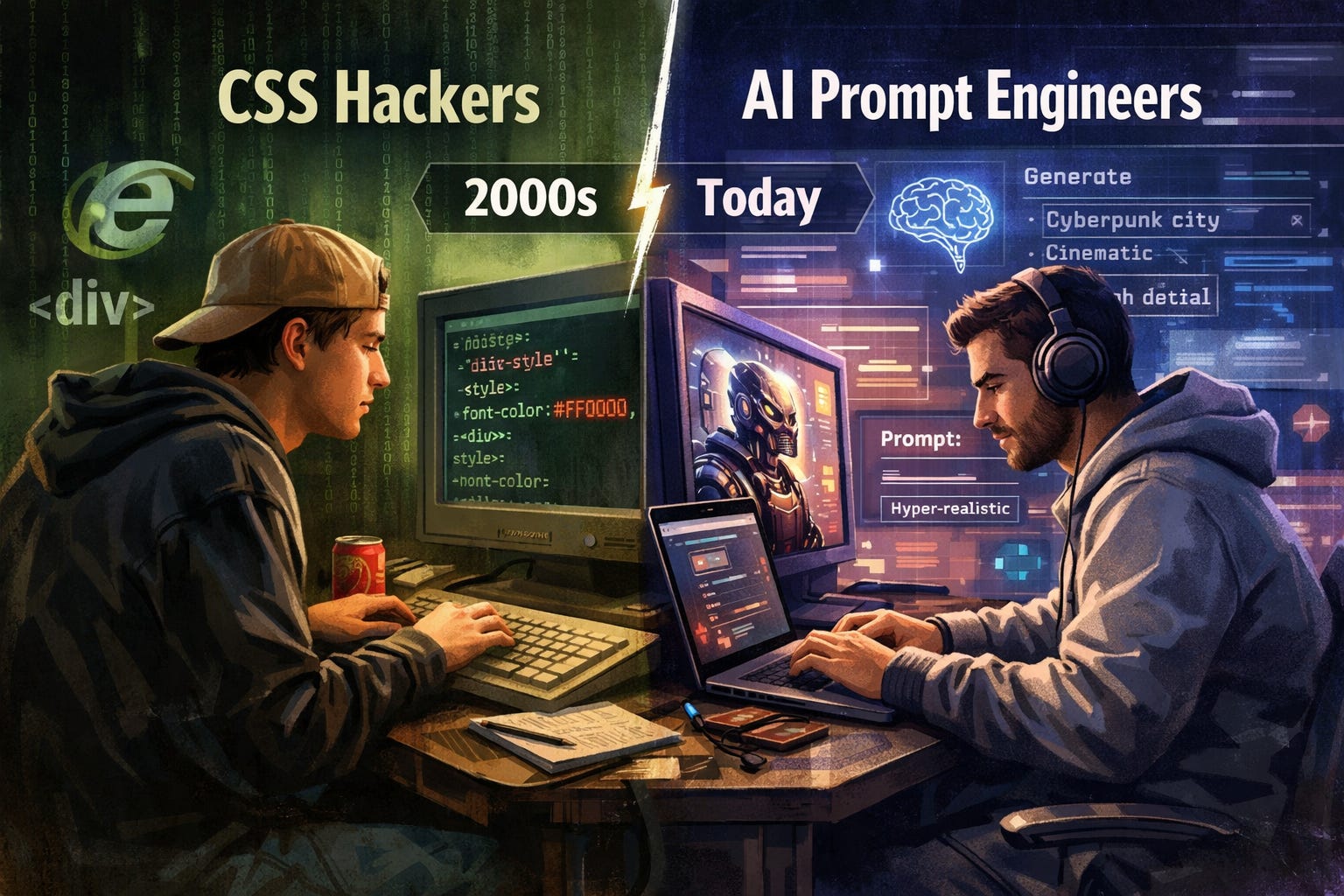
Today, AI mirrors this ethos. Instead of View Source, we have the “prompt.” We describe a user interface, a code snippet, or an interaction, and the AI conjures it into existence. It’s an abstract form of “stealing,” not from a single creator, but from the aggregated knowledge of the entire digital universe. We’re remixing concepts, styles, and functionalities at massive scale. The “prompt engineer” of today is the spiritual successor to the CSS hacker of yesteryear, both driven by the desire to manifest an idea with minimal friction and maximum impact. It’s a return to playful subversion, where boundaries are dictated not by framework strictures, but by the limits of our imagination.
The Rise of the “Gray Web”
Then came the reckoning. The wild west couldn’t scale. Businesses needed consistency, developers needed efficiency, and users demanded predictability. Enter Bootstrap, Material Design, and countless corporate design systems. We gained usability and scalability, but we bled soul. Every SaaS landing page started to look identical: the same hero section, the predictable three-column pricing, the ubiquitous sans-serif font, the reassuringly bland call-to-action buttons.
The web became a meticulously paved road, efficient and smooth, but devoid of interesting detours or unexpected vistas. We reached “Peak Consistency,” where the fear of alienating a user with a novel interaction outweighed the joy of surprising them with something truly original. It was safe, it was reliable, but it was, undeniably, boring.
Why AI is the “Chaos Engine” We Need
This era of standardised interfaces left a void. A longing for the expressive, the experimental, the delightfully unhinged. This is where AI enters as a “chaos engine,” allowing us to break free from the very grids and guidelines we meticulously built.
Why This Matters Now:
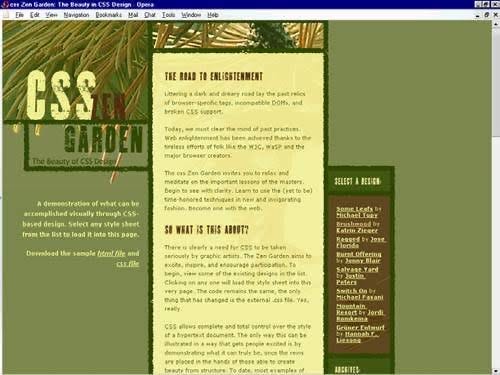
Anyone can build weird shit now: Just as CSS Zen Garden showcased how dramatically visual presentation could change, AI empowers designers and non-designers to manifest complex visual and interactive ideas almost instantly. You no longer need to master Figma, React, or SASS. A well-crafted prompt can generate an entire UI concept. It democratises creation, putting powerful tools in the hands of anyone with a vision.
Grids are optional again: AI doesn’t inherently care about 12-column grids or atomic design principles unless explicitly instructed. It can generate maximalist designs, fluid interfaces, and entirely novel visual metaphors that defy traditional layout conventions. Imagine interfaces that adapt not just to screen size, but to mood, context, or personal aesthetic preference, generated on the fly.
You can ask “what if” and actually find out: The early web was defined by the question, “Can I make the browser do this?” AI allows us to ask, “What if this interface looked like a 1970s sci-fi movie poster, but was also fully interactive and accessible?” and see it materialise in seconds. This immediate gratification, this ability to explore fantastical concepts with minimal effort, reignites the playful, experimental spirit that fuelled the early web. It’s about rapid ideation, about dreaming bigger, and about rediscovering the sheer fun of creation without the crushing weight of implementation constraints.
The web is about to get weird again. And that’s exactly what we need.